
5 Ways to Troubleshoot Central AC Not Turning On
Last Updated: October 25, 2026
Quick Summary
A central AC that won't turn on is usually a power, thermostat, or safety-switch problem, not a dead compressor. Check the thermostat settings and batteries first, then the main panel breaker, outdoor disconnect, and indoor air-handler switch. A dirty filter or tripped condensate float switch can also shut the system down.
- Set the thermostat to COOL, fan to AUTO, and at least 3 degrees below room temperature.
- A central AC needs power at four points: main breaker, outdoor disconnect, air-handler switch, and low-voltage circuit.
- Wait at least 5 minutes after any reset before expecting the system to restart.
- Never bypass a float switch, since it prevents drain pan overflow and water damage.
- Call a technician if the breaker trips again or the system runs but blows warm air.
Table of Contents
- Why Your Central AC Won't Turn On: No-Start vs. Not Cooling
- Check the Thermostat First When Your AC Thermostat Is Not Working
- Inspect the Air Conditioner Circuit Breaker Tripped or Power Supply
- Replace a Dirty Air Filter and Check the Condensate Drain
- Understand Air Conditioner Reset Time and What It Means
- When to Call an HVAC Technician for AC Repair
- Request Same-Day AC Service in Mansfield and the South Shore
- Frequently Asked Questions
Why Your Central AC Won't Turn On: No-Start vs. Not Cooling
A central AC that won't turn on is usually a power, thermostat, or safety-switch problem, not a dead compressor.
Here is the first thing most guides get wrong.
A no-start central AC shows no fan, no hum, no air. The system is getting no signal or no power.
A not-cooling central AC runs, but the air is warm. Power is fine.
Below, we walk through five safe checks in order. Each one takes minutes and costs nothing. The five checks cover the failures we see most often on no-start calls.
The two failure modes send you down different diagnostic paths, so start by matching the symptom.
| Symptom | What you notice | Where the problem sits |
|---|---|---|
| No-start | No fan, no hum, no air | Power, thermostat, or safety switch |
| Not cooling | System runs, but air is warm | Airflow, refrigerant, or compressor |
Check the Thermostat First When Your AC Thermostat Is Not Working
An AC thermostat not working is the most common reason a central AC won't start. Before you touch anything else, confirm the thermostat is actually asking for cool air.
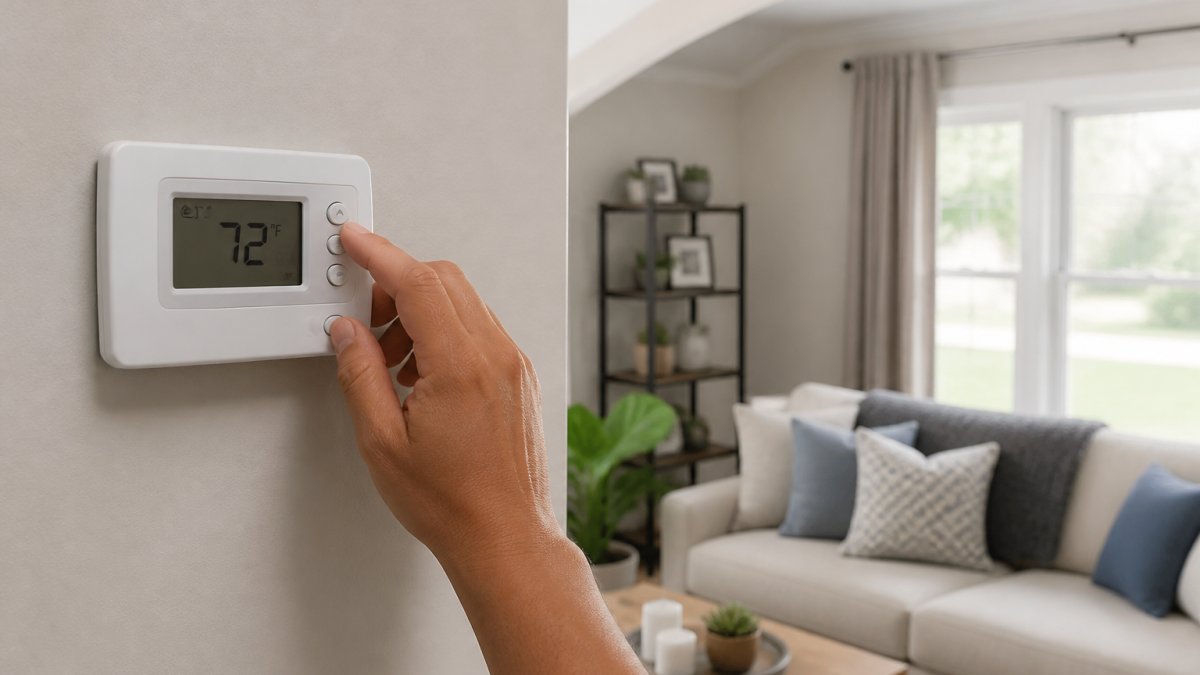
Thermostat Settings, Batteries, and Display Errors
Start with the basics, because they solve a surprising share of no-start calls.
- Mode: Set to COOL, not HEAT, OFF, or FAN.
- Fan setting: AUTO, not ON. In ON, the blower runs with no cooling.
- Temperature: Set it at least 3 degrees below room temperature.
Watch out: if the display is blank after fresh batteries, the thermostat may have lost low-voltage power from the air handler. That is a wiring issue, not a battery issue.
Inspect the Air Conditioner Circuit Breaker Tripped or Power Supply
An air conditioner circuit breaker tripped is the second most common no-start cause, but the breaker is only one link in a chain. A central AC needs power at four points before it will start: the main panel breaker, the outdoor disconnect, the indoor air-handler switch, and the low-voltage control circuit.
Work the chain in order. It takes about five minutes and keeps you on the safe side of the panel.
Step 1: The Main Panel Breaker
- Open the panel cover only, never remove the dead front or touch the wiring inside.
- Find the breaker labeled for the AC. Central ACs usually use a double-pole breaker (two linked switches) rated for the condenser's nameplate amps.
- A tripped breaker sits in the middle position, not fully OFF and not fully ON.
Step 2: The Outdoor Disconnect
Most condensers have a gray disconnect box mounted on the wall within sight of the unit. It holds either a pull-out handle or a flip switch.
- Pull the handle straight out, inspect it for corrosion or melting, and push it firmly back in.
- On a flip-switch disconnect, confirm it is fully ON.
- If the handle or switch looks burned or will not seat, leave it out and call for service. A loose disconnect is a fire risk.
A common pattern technicians find: the panel breaker is fine, but the outdoor disconnect was pulled for service and never fully reinserted. That single check solves a surprising share of no-start calls.
Step 3: The Indoor Air-Handler Switch
The air handler in the attic, closet, or basement often has its own power switch or breaker. It may be a light-switch-style unit on the side of the cabinet or a dedicated breaker in a subpanel.
- Confirm the switch is ON and the breaker is not tripped.
- If the air handler has a condensate float switch wired in series, a full drain pan can cut power here, see the next section.
Step 4: The Low-Voltage Control Circuit
The thermostat sends a 24-volt signal to the air handler and condenser. If that circuit is open, the system will not start even with full line power.
- A blank thermostat display after fresh batteries usually means the low-voltage transformer or the control wiring has lost power.
- A tripped float switch, a blown low-voltage fuse on the air-handler control board, or a broken thermostat wire can all open this circuit.
- Do not jumper or bypass control wiring to test it. That is technician work.
What to Do After a Breaker Trips Again
A breaker that trips once is normal. A breaker that trips again right after reset is a warning.
Stop resetting it. A breaker that trips repeatedly points to a real electrical issue: a short, a failing compressor, a bad condenser fan motor, or a loose connection.
Call a licensed technician at that point. Repeated trips are not a DIY problem.
Replace a Dirty Air Filter and Check the Condensate Drain
A dirty air filter chokes airflow and can freeze the indoor coil, which then shuts the system down on a safety. Replace it, or clean it if it is reusable.
Then check the condensate drain line and float switch. This is the check most guides skip, and it is central AC-specific. A tripped float switch looks exactly like a dead system: no fan, no hum, no response at the thermostat.
How the Condensate Float Switch Works
As the indoor coil cools, it pulls moisture out of the air. That water runs into a drain pan and out a drain line. If the line clogs with algae or sludge, the pan fills. A float switch, a small safety device mounted in the pan or on the drain line, rises with the water and opens the low-voltage control circuit, shutting the system off before water overflows into the ceiling.
There are two common types:
- Pan-mounted float: a puck-shaped switch that sits in the auxiliary pan under the air handler.
- Inline float: a switch installed on the primary drain line that trips when the line backs up.
Diagnosing a Tripped Float Switch
- Look for water: pooling water or a stained pan near the air handler is the clearest sign.
- Check the display: a thermostat that is blank or showing no call for cool while the breaker is on points to an open safety circuit.
- Find the switch: follow the drain line from the air handler to the pan or the inline fitting.
If the pan is full, clear the clog before resetting. Pour a cup of distilled white vinegar down the drain line access port to break up algae, or use a wet/dry shop vacuum on the outdoor drain termination to pull the clog out. Then flush with water and confirm the line drains freely.
When the Float Switch Keeps Tripping
A float switch that trips again after you clear the line points to a deeper problem: a drain line with a persistent slope issue, a cracked pan, or a secondary drain that is also clogged. At that point, stop resetting it and call a technician.
For a deeper walkthrough, see our guide on how to stop central AC leaking water inside the house.
Understand Air Conditioner Reset Time and What It Means
Air conditioner reset time is the delay a system needs before it will restart after a shutdown.
If you just reset the breaker or the float switch, wait before you panic.
- Wait at least 5 minutes after any reset.
- Listen for the outdoor unit to hum and the condenser fan to spin.
- Check the indoor blower for airflow at the vents.
If nothing happens after the delay, the problem is upstream: power, thermostat signal, or a failed component. If the system starts and stops repeatedly, that is short cycling, and it needs a technician.
When to Call an HVAC Technician for AC Repair
Call an HVAC technician for AC repair when the five checks above come up clean, when a breaker trips again, or when the system runs but blows warm air. Before you call, you can review central AC repair costs and pricing to understand typical repair costs. Those signs point to refrigerant leaks, a failing compressor, or electrical faults that require gauges, meters, and a license.
Safety boundaries matter here. Do not open the outdoor unit's electrical panel. Do not add refrigerant. Do not bypass a float switch. Low refrigerant charge and compressor work are EPA-regulated tasks for certified technicians.
Our team is MA licensed, fully insured, and EPA 608 certified. We also hold an oil burner license. You can review our HVAC repair and installation services and see how our straightforward pricing works.
Request Same-Day AC Service in Mansfield and the South Shore
When a no-start turns into a repair, speed matters. We offer 24/7 emergency service and same-day appointments across Mansfield and the South Shore. One customer called on a Friday night when the heat went out; our technician arrived within two hours and had it running before midnight.
Here is how we work:
- We diagnose first, then quote before any repair.
- No surprise add-ons mid-job.
- Licensed, insured technicians on every call.
Ready to book? Get in touch with our team for a free quote or emergency service.
Frequently Asked Questions
What should I check first if my central AC won't start?
Start with the thermostat. Confirm it is set to COOL, the temperature is below the current room temperature, and the fan is set to AUTO or ON. Check the batteries and look for any error codes on the display. If the thermostat looks fine, move to the circuit breaker and the indoor and outdoor power switches. These first checks solve a surprising number of central AC no-start calls without any tools.
Can a tripped breaker stop an air conditioner from turning on?
Yes. A tripped air conditioner circuit breaker cuts power to the unit, so the outdoor condenser and indoor air handler will not run. Find the breaker labeled for your AC in the main panel and check whether it sits in the middle position. Flip it fully to OFF, then back to ON. If it trips again right away, stop resetting it and call a licensed technician, because a repeat trip usually points to a failing component or a wiring fault.
How long should I wait before restarting my air conditioner?
Wait at least 5 minutes after turning the system off before you turn it back on. This protects the compressor from short-cycling and pressure damage. Some thermostats build in a short delay of their own, which is normal. If the unit still will not start after the wait, recheck the thermostat settings and the breaker before assuming the compressor has failed.
When should I call an HVAC technician for AC repair?
Call a technician when the breaker trips more than once, when you see ice on the refrigerant lines, when the outdoor fan does not spin, or when the unit hums but will not start. Also call if you smell burning or see water around the indoor unit. These signs point to electrical faults, low refrigerant charge, or a failed compressor, and they are outside the safe scope of homeowner troubleshooting.
Your AC quitting on the hottest day of the year is stressful, but most no-start calls trace back to a thermostat setting, a tripped breaker, or a clogged drain line. When the checks run out, get a licensed pro on site fast. Get started with Oil gas heating ac cooling service and installation and get your cooling back the same day.

Need HVAC service in Mansfield, MA?