
Best Furnace for an Older Home: 2026 Buying Guide
Table of Contents
- Best Furnace for an Older Home: What Actually Matters
- Gas vs Oil Furnace for an Older Home
- Furnace Sizing for Older Homes: Heat Loss Before BTU
- Furnace Installation Cost for an Older Home
- Ductwork Upgrades for Older Homes
- AFUE, Venting and Combustion Safety in Older Buildings
- Furnace Replacement vs Heat Pumps and Hybrid Systems
- Frequently Asked Questions
Last Updated: October 19, 2026
Best Furnace for an Older Home: What Actually Matters
Choosing the best furnace for an older home is less about brand loyalty and more about matching equipment to a building that was never designed for modern heating loads. At Whole Home Comfort Systems, we have spent more than 20 years installing and repairing oil and gas furnaces, boilers, and ductless mini-splits in older houses, and the pattern is consistent: the furnace that performs best is the one sized, vented, and ducted for the house it actually sits in.
That is the core problem with most buying advice. It ranks furnaces by efficiency ratings and warranty length, then hands the same shortlist to every homeowner. An older building has different rules.
Why Older Homes Need a Different Furnace Shortlist
Three things separate an older house from a new build: looser envelopes, undersized or unsealed ductwork, and venting systems built for equipment that no longer exists. A furnace that wins on paper in a new construction spec sheet can underperform badly in a 1950s Cape with 6-inch ducts and a masonry chimney.
A common mistake is buying the highest-AFUE model available and assuming efficiency follows. In practice, a high-efficiency condensing furnace connected to leaky ducts and an unlined chimney often delivers less comfort than a mid-efficiency unit with a properly sized distribution system.
Gas vs Oil Furnace for an Older Home
The fuel decision usually comes down to what already exists in the house.
Sticking with oil makes sense when the tank is sound and the chimney is compatible. Switching to gas makes sense when a gas main is already at the house and the existing venting can be adapted.
| Factor | Gas Furnace | Oil Furnace |
|---|---|---|
| Fuel delivery | Piped, no storage | On-site tank, scheduled delivery |
| Venting | Often PVC or metal, depending on efficiency | Typically chimney or power vent |
| Conversion cost | Higher if no existing gas line | Lower if tank and vent are sound |
| Best for | Homes with gas already at the property | Homes with a serviceable tank and chimney |
For a deeper look at combustion equipment and venting standards, the U.S. Department of Energy guidance on furnace types is a useful starting point.
Furnace Sizing for Older Homes: Heat Loss Before BTU
Furnace sizing for older homes should start with a room-by-room heat loss calculation, not a square-footage formula. The right size is the one that matches the building's actual heat loss on the coldest design day, and older buildings vary enormously in how much heat they lose.
Why the Old Rule of Thumb Fails in Older Buildings
The "BTU per square foot" shortcut assumes a fairly tight, uniformly insulated house. Older homes break every assumption in it: uninsulated walls, single-pane windows, attic bypasses, and additions built to different standards than the original structure.
A proper Manual J load calculation accounts for window area and glazing type, insulation levels, air leakage, duct location, and orientation.
Oversizing is the more common error, and it has consequences: short cycling, uneven temperatures, higher humidity in summer, and more wear on the heat exchanger.
Furnace Installation Cost for an Older Home
Furnace installation cost for an older home is driven less by the furnace and more by the surrounding work. The equipment is one line item. The rest is venting, duct modifications, electrical, permits, and whatever the inspection turns up. Competitors tend to quote a single installed range and stop there; the more useful approach is to separate equipment, labor, and the older-home extras so you can see where the money actually goes.
What the Equipment Itself Costs
A standard-efficiency gas furnace typically runs in the low-to-mid four figures for the unit alone, while a high-efficiency condensing model adds a premium that is partly offset by lower operating cost over its service life. Oil furnaces sit in a similar band but carry different venting and tank considerations. Treat any single "average installed price" you see online with suspicion: it usually assumes a new-construction closet, an existing vent path, and ducts that already work.
The Older-Home Extras That Move the Number
These are the line items that separate a straightforward swap from a real retrofit:
- Venting changes. A switch to a high-efficiency condensing furnace may require new PVC venting, a condensate drain path, and a termination point that meets clearance rules. A power-vented or chimney-vented unit avoids the PVC run but has its own constraints.
- Chimney work. An unlined or deteriorating masonry chimney may need a liner before any new appliance is connected. This is often the single largest surprise line item in an older-home replacement.
- Duct modifications. Transitions, returns, and plenum changes are common when the new unit's dimensions differ from the old one. Undersized trunks may need resizing to deliver the rated airflow.
- Electrical. Older panels sometimes lack capacity for a new blower motor circuit, and a heat pump or hybrid add-on can require a larger service.
- Permits and inspection. Required in most jurisdictions and priced by the local authority. Budget for the permit and the inspection time, not just the sticker fee.
- Removal and disposal. Hauling out the old unit and any tank or venting debris is real labor, especially in basements and crawlspaces with tight access.
Permits, Rebates, and Total Cost of Ownership
A furnace decision is a multi-year cost decision, not a one-day purchase.
Permits matter for more than compliance. A permitted job is inspected, and the inspection is where undersized venting, missing combustion air, and improper clearances get caught.
We quote these as separate line items so you can see exactly what the installation involves before work begins. Our pricing page lists current service rates, and every quote is written before the first tool comes out.
Ductwork Upgrades for Older Homes
Ductwork is where older homes lose the most comfort for the least visible reason. Leaky joints, disconnected runs, undersized trunks, and ducts routed through unconditioned attics or crawlspaces all waste capacity before the air reaches a room. Most buying guides mention ductwork and move on; the practical question is how to diagnose it and when to repair versus replace.
A Practical Duct Inspection Checklist
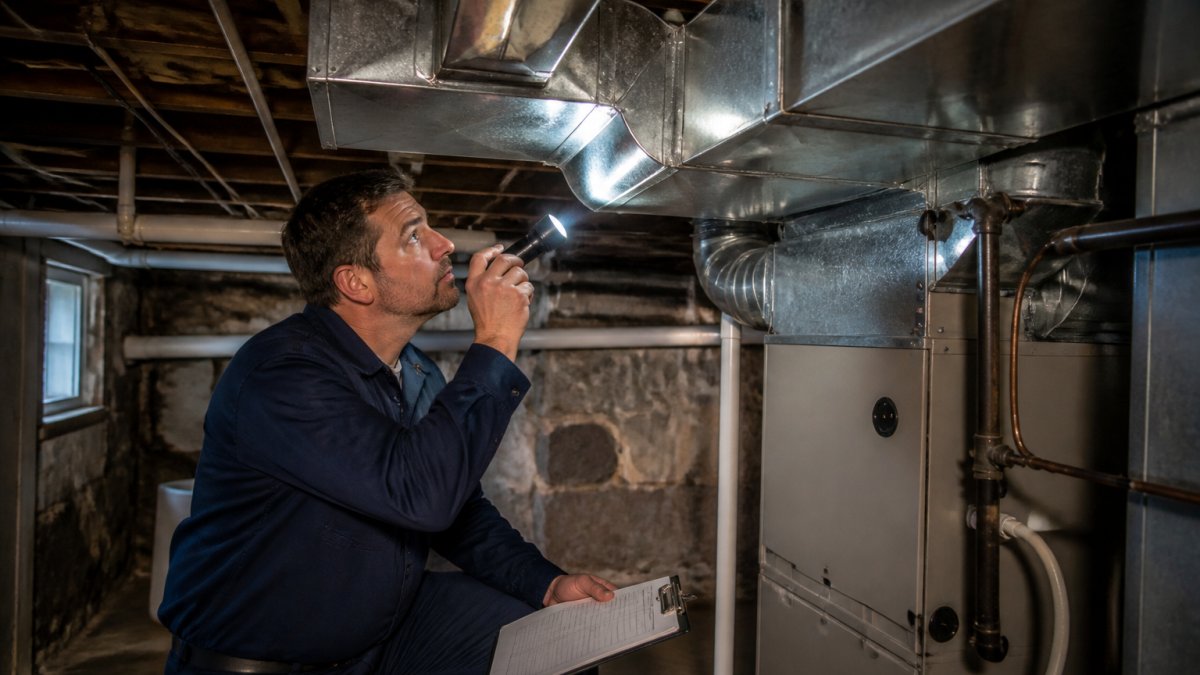
A technician evaluating older ductwork should be able to answer these questions in writing:
- Static pressure. Measured at the supply and return plenums, static pressure reveals whether the blower is fighting a restrictive duct system. High static pressure is the most common reason a correctly sized furnace still underperforms.
- Leakage at accessible joints. Look for disconnected runs, gaps at plenum connections, and joints sealed with failing tape rather than mastic.
- Insulation condition. Ducts routed through unconditioned space should be insulated; bare or damaged insulation in an attic or crawlspace is a direct capacity loss.
- Trunk and branch sizing. Undersized trunks starve distant rooms, and undersized branches cause high velocity and noise.
- Return path. Older homes often have too few returns, which pressurizes rooms and pulls conditioned air out through envelope leaks.
- Routing and obstructions. Crushed flex duct, sharp bends, and runs buried under insulation all restrict airflow.
Repair, Seal, or Replace: Decision Rules
Sealing and balancing are far cheaper than a full duct replacement and often recover enough capacity to change the sizing decision entirely.
Full replacement is justified when ducts are crushed beyond repair, routed through spaces that cannot be sealed, or so undersized that resizing means rebuilding the distribution system. In those cases, compare the cost of a duct rebuild against the cost of a ductless approach before committing.
When Ducts Cannot Be Saved
When ducts genuinely cannot be salvaged, ductless mini-splits are the practical alternative for older homes with no duct path at all. They deliver targeted comfort to problem rooms, additions, and finished attics without tearing open walls. The trade-off is room-by-room equipment rather than central distribution, so the economics depend on how many zones you actually need.
AFUE, Venting and Combustion Safety in Older Buildings
AFUE (Annual Fuel Use Efficiency) is the percentage of fuel energy a furnace converts to heat over a heating season. Standard furnaces typically fall in the 80% range; high-efficiency condensing models reach the mid-90s. The rating matters, but in an older home the venting system decides whether you can actually use it.
What High-Efficiency Venting Demands From an Old Chimney
Condensing furnaces extract so much heat that the flue gas drops below its dew point, producing acidic condensate. That is why they vent through PVC rather than a masonry chimney.
Combustion safety deserves equal attention.
The U.S. Environmental Protection Agency guidance on combustion safety and indoor air covers why this matters, and the NFPA codes and standards for heating appliances set the venting requirements inspectors enforce.
Furnace Replacement vs Heat Pumps and Hybrid Systems
A furnace replacement is not automatically the right call. For older homes, three paths are worth comparing before you commit.
Straight furnace replacement is the simplest option when the duct system is serviceable and the existing fuel setup is sound.
A heat pump or hybrid system pairs an electric heat pump with a furnace as backup.
Ductless mini-splits work where ducts do not exist or cannot be economically repaired.
The right answer depends on your ducts, your electrical service, and how long you plan to stay.
Frequently Asked Questions
What type of furnace is best for an older home?
There is no single answer, because the right furnace depends on your fuel supply, ductwork condition and how leaky the building envelope is. In practice, most older homes do well with a two-stage gas furnace paired with a properly sized blower, since two-stage heating runs longer at lower output and evens out temperature swings in rooms that were never designed for modern airflow. If natural gas is not on your street, a modern oil furnace remains a sensible choice. Get a room-by-room heat-loss assessment before committing to any older home furnace model.
Is a gas or oil furnace better for an older house?
It comes down to what is already in the house and what is available at the curb. If a gas line already runs to the property, switching usually lowers operating cost and removes the need for fuel deliveries and an indoor oil tank. If there is no gas main, converting means paying for a service line and possibly a new vent path, which can erase the savings for years. Oil furnaces still heat well and modern units reach high AFUE ratings, so staying with oil is often the economical call when the tank and chimney are in good shape.
Can you install a high-efficiency furnace in an older home?
Yes, but the venting is usually the deciding factor. High-efficiency condensing furnaces vent through PVC pipe and produce acidic condensate that needs a drain path. Older homes often have a masonry chimney sized for a conventional furnace, and that chimney cannot handle the lower flue-gas temperatures of a condensing unit without a properly sized liner. Budget for a chimney liner, sidewall venting or a condensate pump, and have the contractor confirm combustion air supply before signing. A high-efficiency furnace is still often the right older home furnace choice, just not a drop-in one.
Should I replace the furnace or upgrade the ductwork in an older home?
Diagnose first, then decide. A static pressure test and a duct leakage check tell you whether the existing ducts can move the airflow a new furnace needs. If leakage and pressure problems are moderate, sealing and rebalancing may be enough. If ducts are undersized, buried or run through unheated spaces, ductwork upgrades for older homes often deliver more comfort per dollar than a higher-AFUE furnace on bad ducts. Many homeowners do both in one project to avoid paying twice for labor and permits.
Need HVAC service in Mansfield, MA?