
Central AC Repair Cost and Pricing: 2026 Guide
Table of Contents
- What Central AC Repair Cost and Pricing Actually Includes
- Central AC Repair Cost by Repair Type
- What an AC Diagnostic Fee Covers Before Any Work Begins
- Emergency AC Repair Cost: Why After-Hours Calls Cost More
- AC Repair vs Replacement Cost: How to Decide
- What a Transparent Repair Quote Should Include
- Warranty, Insurance, and Maintenance Plan Coverage
- Conclusion: Getting Straight Answers on Central AC Repair Cost
- Frequently Asked Questions
Last Updated: October 12, 2026
What Central AC Repair Cost and Pricing Actually Includes
Central AC repair cost and pricing comes down to three moving parts: the diagnostic fee to find the problem, the labor to fix it, and the parts required. According to the U.S. Department of Energy's guide to home cooling, a cooling system that runs poorly or fails outright usually traces back to a handful of common components, and identifying which one failed is what drives the final bill.
That's why we quote before we start. No surprise costs, no mid-job additions.
Labor, Parts, and Fees: The Three Cost Buckets
Every legitimate AC repair estimate breaks into three buckets:
- Diagnostic fee covers the service call and the technician's time to find the fault
- Labor covers the hours to complete the repair, billed at an hourly rate
- Parts covers the failed component, which varies widely by system age and type
A common mistake is comparing only total prices. Two estimates can look identical on the bottom line while one hides a diagnostic fee and the other folds it into labor. Ask for the breakdown in writing.
Central AC Repair Cost by Repair Type
The cost of a central AC repair depends mainly on which component failed, how hard it is to reach, and whether refrigerant work is involved. A capacitor swap is quick and cheap; a compressor replacement is the opposite, expensive part, long labor, and often the point where replacement makes more sense.
Common Component Failures and What They Cost
| Component | Typical Repair Nature | Parts Cost | Labor Time | Typical Total Range |
|---|---|---|---|---|
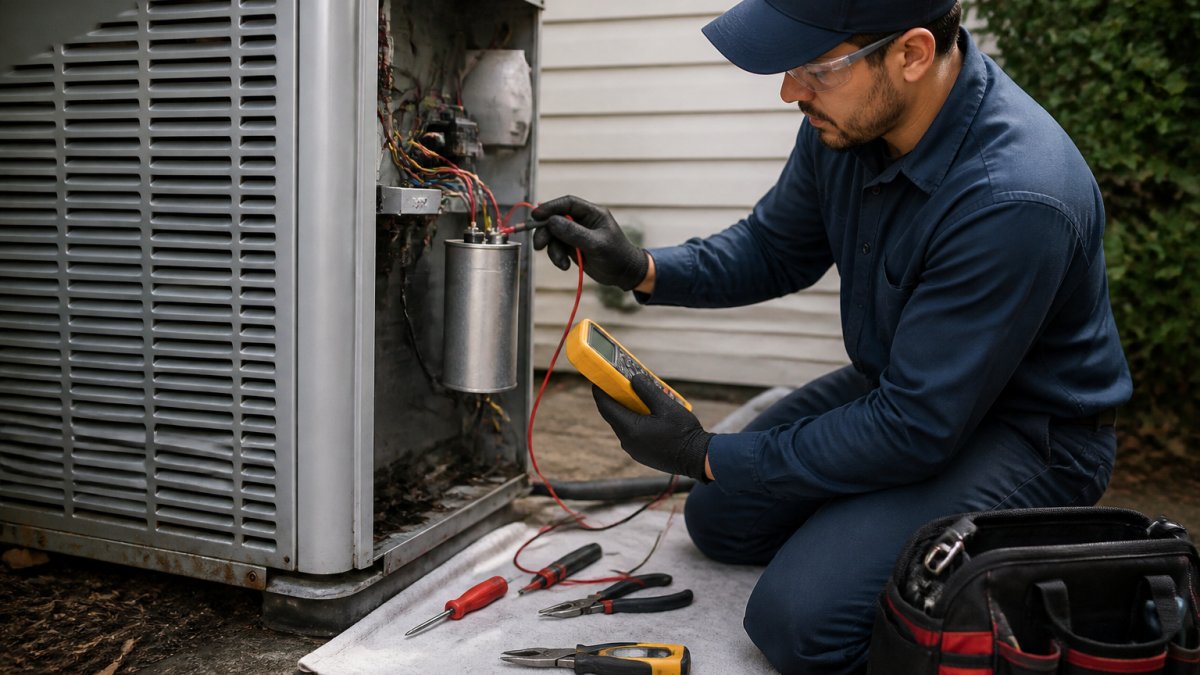
| Capacitor | Quick swap, single part | $15-$60 | Under an hour | $150-$350 |
| Contactor | Quick swap, single part | $20-$80 | Under an hour | $150-$400 |
| Blower motor | Motor replacement, access varies | $150-$500 | 1-3 hours | $450-$1,200 |
| Condenser fan motor | Fan motor replacement | $150-$450 | 1-2 hours | $400-$1,000 |
| Evaporator coil | Coil replacement, refrigerant work | $600-$2,000 | Several hours | $1,200-$3,500 |
| Compressor | Major replacement, refrigerant recovery | $800-$2,500 | Full day or more | $1,500-$4,500 |
| Refrigerant leak | Leak search, seal, recharge | Varies by refrigerant | 2-5 hours | $400-$1,800 |
| Drain line clog | Clearing, flushing | Minimal | Under an hour | $100-$250 |
| Thermostat | Swap or rewire | $50-$300 | Under an hour | $150-$500 |
Why the Same Repair Can Cost Twice as Much
Two homeowners with the same failed blower motor can get quotes differing by hundreds of dollars. The reasons are consistent:
- Refrigerant type. Systems using R-22 (an older refrigerant phased down under EPA regulations on refrigerants) cost more to recharge than systems using R-410A or newer refrigerants, and parts for R-22 equipment are increasingly scarce.
- System capacity. A 5-ton unit takes more refrigerant and larger components than a 2-ton unit, so the same repair costs more on a bigger system.
- Access and location. A coil in an attic or a compressor behind a fence takes longer to reach than one in an open basement or side yard.
Minor vs. Major Repairs: Where the Line Sits
A useful rule of thumb: minor repairs are almost always worth doing. Repairs that are more substantial are judgment calls that depend on system age. Repairs on a system older than 10-12 years usually tip toward replacement, since the cost approaches a meaningful fraction of a new system and the unit will likely need more work soon.
What a Repair Quote Should Separate
When comparing estimates, ask each provider to break the number into these line items:
- Diagnostic or service call fee, stated separately from repair labor
- Labor hours and the hourly rate
- Each part by name and cost
A lump-sum quote hides where the money goes. An itemized quote shows whether the gap between two estimates is in the diagnostic fee, the labor rate, or the parts markup, usually where the real difference lives.
What an AC Diagnostic Fee Covers Before Any Work Begins
An AC diagnostic fee pays for the technician's time to inspect the system, test components, and identify the actual fault before any repair work starts.
Here's what a fair diagnostic visit should include:
- A full inspection of the indoor and outdoor units
- Testing of capacitors, contactors, motors, and thermostat function
- Refrigerant pressure check and a refrigerant leak assessment if readings are off
If a company won't tell you the diagnostic fee up front, that's a red flag. At Whole Home Comfort Systems, we give you a clear quote before work begins, so you know the out-of-pocket cost before you approve anything.
Emergency AC Repair Cost: Why After-Hours Calls Cost More
Emergency AC repair costs more than a standard service call because the technician is working outside normal hours, often at night or on a weekend. After-hours service carries a premium for the same reason a plumber or electrician charges more at 2 AM: it disrupts schedules and requires on-call staffing. Seasonal demand pushes it higher still. When a heat wave hits, everyone's cooling system fails at once.
The "will they actually show up?" worry is legitimate, plenty of companies advertise 24/7 emergency service and leave you waiting all day. We staff real on-call coverage, and one customer put it plainly:
"Called them on a Friday night when our furnace went out. Technician was at our house within two hours and had heat back on before midnight. Incredibly professional and fair pricing. Won't use anyone else."
AC Repair vs Replacement Cost: How to Decide
The repair-versus-replace decision hinges on system age, repair complexity, refrigerant type, and remaining life. When a repair costs a large fraction of a new system and the unit is already old, replacement usually wins on total cost of ownership. When the unit is newer and the fix is minor, repair is the clear choice.
The 50% Rule, Adjusted for Age
A widely used starting point is the 50% rule: if the repair costs more than half the price of a new system, replace rather than repair. But the rule ignores how old the unit is. A better framework combines repair cost with remaining life:
| System Age | Repair Cost | Better Choice |
|---|---|---|
| Under 8 years | Any repair | Repair |
| 8-12 years | Under $500 | Repair |
| 8-12 years | $500-$1,500 | Repair, but get a replacement quote for comparison |
| 8-12 years | Over $1,500 | Lean replace |
| Over 12 years | Under $500 | Repair, but plan for replacement within 1-2 years |
| Over 12 years | Over $500 | Replace |
| Any age | Repeated failures in one season | Replace |
| Any age | Undersized or inefficient system | Replace |
A typical central AC system lasts 12-15 years with regular maintenance. If your unit is past that window and facing a major repair, the money is usually better spent on a new, more efficient system with a fresh warranty.
The Age, Capacity, and Refrigerant Factors
Three equipment-specific variables explain why two homeowners with the same apparent fault get very different advice:
- System age: Older units are more likely to need repeat repairs, so a single fix rarely stays the last one. A 14-year-old system that needs a $900 repair today may need another $900 repair next summer.
- Capacity and efficiency: An undersized system may never cool your home well, no matter how many repairs you throw at it. An older, low-SEER unit also costs more to run every month, so replacement can pay back part of its price through lower utility bills.
- Refrigerant type: Systems using R-22 have been phased down under EPA regulations on refrigerants, which makes certain repairs harder, parts less available, and recharges more expensive. If your system uses R-22 and needs refrigerant work, that alone can push the decision toward replacement.
How to Compare the Two Paths on Total Cost
Don't compare the repair quote to a new system's sticker price. Compare total cost of each path over the next 5-7 years:
- Repair path: repair cost today + likely follow-up repairs + higher monthly energy use on an aging unit + no new warranty coverage.
- Replace path: installation cost + lower monthly energy use + new parts and labor warranty + a fresh 12-15 year service life.
For an older system facing a major repair, the repair path often costs more over that window once follow-up repairs and energy use are counted. For a newer system with a minor failure, repair wins easily.
What to Ask Before You Decide
Ask any provider these questions before committing to either path:
- What is the remaining expected life of this system?
- What is the total cost of the repair, itemized?
- What is the installed cost of a comparable new system?
We walk through this with every homeowner before recommending anything, because the honest answer isn't always the expensive one. Sometimes the right call is a $250 capacitor; sometimes it's a new system. Use the same framework to sanity-check any quote you receive.
What a Transparent Repair Quote Should Include
A transparent repair quote lists the diagnostic fee, labor, specific parts, and total out-of-pocket cost in writing before any work begins. A lump-sum quote won't tell you whether you're being charged fairly.
Ask any provider for these line items:
- The diagnostic or service call fee, stated separately
- Labor hours and the hourly labor rate
- Each part by name, with its cost
This is the "straightforward pricing" question we hear most often: what's the catch? There isn't one. The quote you approve is the price you pay. If we find something else wrong mid-job, we stop and tell you first.
Warranty, Insurance, and Maintenance Plan Coverage
Warranty, insurance, and maintenance plan coverage can all reduce your out-of-pocket cost, but each covers different things. Manufacturer warranties typically cover failed parts within a set period, though labor is often excluded.
A tune-up is the cheapest insurance you can buy. Seasonal maintenance catches a failing capacitor or slow refrigerant leak before it becomes a mid-summer emergency, especially valuable in older homes.
Conclusion: Getting Straight Answers on Central AC Repair Cost
The frustration with central AC repair cost and pricing usually isn't the number itself. It's not knowing the number until it's too late.
Whole Home Comfort Systems has served homeowners across Mansfield and the South Shore for over 20 years, with same-day service, 24/7 emergency availability, and straightforward pricing backed by clear quotes before work begins.
Request service with Whole Home Comfort Systems and get an honest answer on repair or replacement before you spend a dollar.
Frequently Asked Questions
What factors affect the cost of central AC repair?
The biggest drivers are the failed component itself, the labor hours required to reach and replace it, and whether the call is during normal hours or after-hours. System age, capacity, efficiency rating, and refrigerant type also matter, since older R-22 systems use refrigerant that is no longer produced and costs more to service. Parts availability and local pricing add further variation, which is why two identical symptoms can produce very different quotes.
What should a central AC repair estimate include?
A complete estimate should separate the diagnostic fee, labor rate and estimated hours, parts cost with part numbers, and any refrigerant charges. It should state whether the diagnostic fee is credited toward the repair, whether the quote is flat-rate or time-and-materials, and what warranty applies to the part and the labor. Ask for the total out-of-pocket cost in writing before authorizing work so nothing gets added mid-job.
Will homeowners insurance cover central AC repair?
Standard homeowners policies usually exclude AC repair caused by wear and tear, age, or lack of maintenance. Coverage typically applies only when a covered peril caused the damage, such as a fire, falling tree, or vandalism. If a power surge or storm damaged the unit, document it and call your insurer before scheduling the repair. Otherwise, expect the repair to be an out-of-pocket cost, and check whether a home warranty or maintenance plan applies.
When is it more cost-effective to replace a central AC unit than repair it?
A common rule of thumb is that if the repair costs a significant fraction of a new system's installed price and the unit is over 10 to 12 years old, replacement usually makes more financial sense. Other signals include a refrigerant leak that keeps returning, a failed compressor on an aging system, or efficiency ratings well below current standards. Get both quotes side by side and compare five-year total costs, not just today's bill.
Need HVAC service in Mansfield, MA?